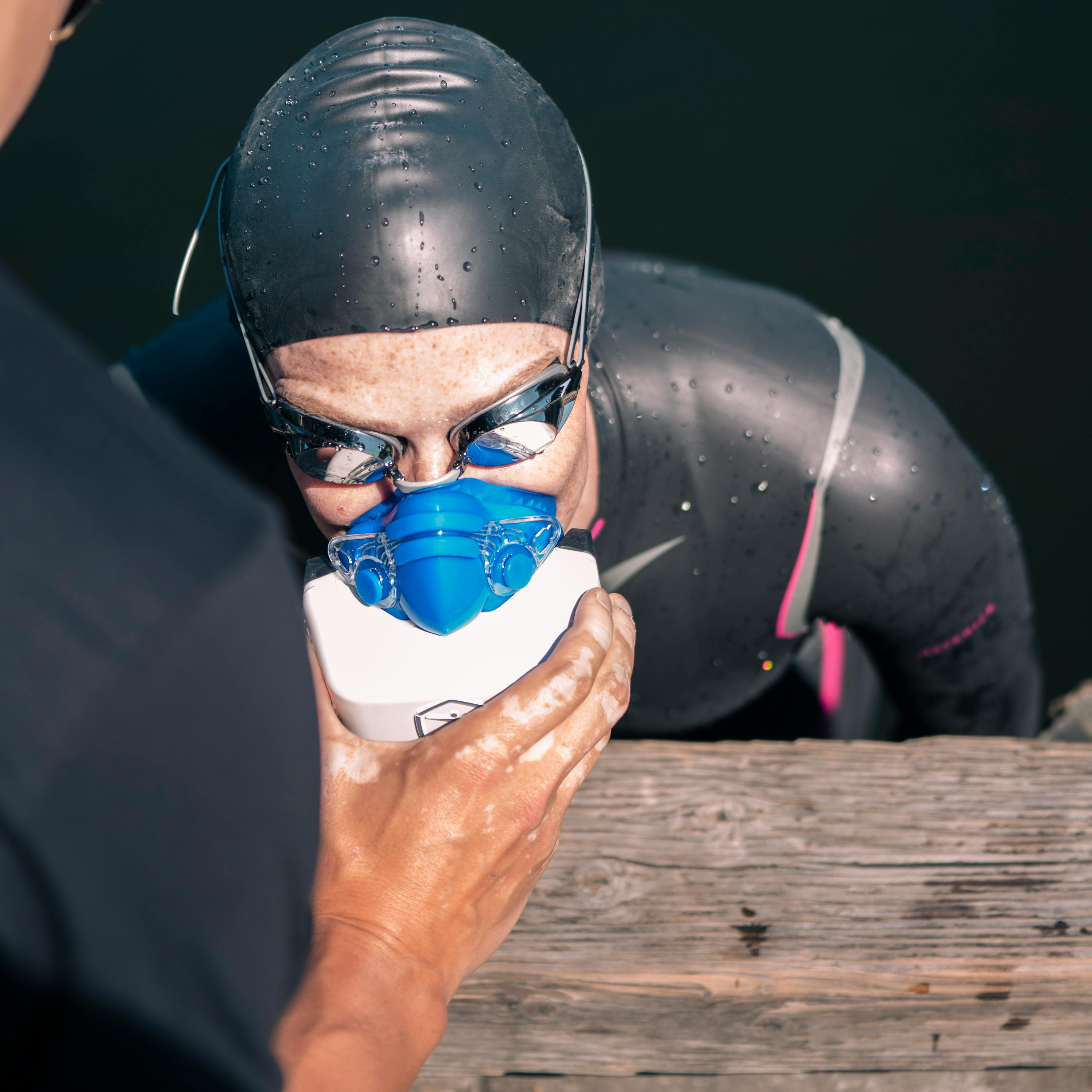
VO Health's first abstract from our ongoing clinical trial has been published in the Journal Physiology by the American Physiological Society.
Abstract
Background: Peak oxygen uptake (VO2peak) is a determinant of human performance and predictor of mortality risk but is under-utilized clinically due to logistical constraints. A scalable blood-based biomarker of functional capacity has the potential to improve risk stratification and guide health-promoting interventions. Objective: Generate a predictive algorithm that accurately predicts VO2peak using the circulating proteome of resting blood samples. Hypothesis: Based on our analysis of the HERITAGE dataset, we hypothesized we could explain 60% of the variance in VO2peak with a sample size of n=50. Methods: We measured VO2peak on 50 subjects (n=28 females, 25 to 77 years) on either a rowing or cycling ergometer with a starting workload of 50-100 watts (W) and incrementation rate of 15-30 W/min. A fasted serum blood draw was obtained pre-exercise. Serum was isolated, frozen at -20°C for ~4 hours and then stored at -80°C until analysis. Proteins were quantified with a sandwich immunoassay and bead-based encoding-decoding system enabling absolute quantification of ~1,000 proteins (nELISA technology). Data. VO2 data was time-aligned to exercise onset, inspected for outliers, and the highest 30 sec rolling average was taken as VO2peak. Proteome data was pre-processed for missingness and differential abundance. The prediction algorithm involved filtering and censoring-aware handling of proteins, followed by fitting a penalized linear regression model with feature filtering performed within the training loop to define the subset of proteins considered. Model training and tuning were conducted using subject-level cross-validation to preserve participant-level independence across repeated measurements. Model performance was evaluated with mean absolute percent error (MAPE), bias, variance, and limits of agreement. Models included adjustment for anthropometric and demographic covariates. Individual protein importance was evaluated with repeated 10-fold cross-validation and on a test set of permutated proteins to calculate the change in MSE. Results: Age, height, and weight was 44±13 years, 172±10 cm, and 78.0±13.6 kg, respectively. Clinical chemistries were relatively normal (glucose: 103±8 mg/dl, low-density lipoprotein: 123±30 mg/dl, high-density lipoprotein: 76±19 mg/dl, apolipoprotein B: 86±21 mg/dl). At peak exercise, RER was 1.13±0.08, workload was 237±67 watts, and heart rate was 171±14 bpm. VO2peak (3.47±0.91 L/min, 45±8 ml/kg/min) placed subjects in the 96th percentile by age/sex on average. A VO2 plateau was observed in 41 subjects. The first and second ventilatory thresholds occurred at 61±14% and 83±18% of VO2peak, respectively. In the adjusted model with blood proteins + age and sex as covariates, predicted VO2peak was within 5 ml/kg/min in 69% of subjects (95% CI: 56-82%). There was a strong correlation with VO2peak (r=0.78, 95% CI: 0.69-0.87), explaining 60% of the variance (r2 = 0.60, 95% CI: 0.42-0.75). MAPE was 10% (95% CI: 7.8-13.0%) and bias was 0.14 ml/kg/min (95% CI: -1.68-1.44). The adjusted model retained 10 proteins, 2 being positive while 8 were negative predictors. Conclusions: In a diverse and above-average fitness sample we demonstrate VO2peak can be predicted from the serum proteome. This was the first cohort of a longitudinal prospective study, and we expect to improve model precision as we move towards our target of n=300. An accurate blood-based VO2peak would enable widespread use of cardiorespiratory fitness to guide treatment and improve functional capacity, while also delivering individual protein insights that can be leveraged as therapeutic targets.
This abstract was presented at the American Physiology Summit 2026 and is only available in HTML format. There is no downloadable file or PDF version. The Physiology editorial board was not involved in the peer review process.
Update: Since publication, VO Health has grown our dataset nearly 5x, and we're exploring the connection between VO2 Max/VO2 Peak and blood-based proteomic biomarkers.
Link: https://journals.physiology.org/doi/abs/10.1152/physiol.2026.41.S1.2344815

Written by
Sean Langan, PhD
Reading Time