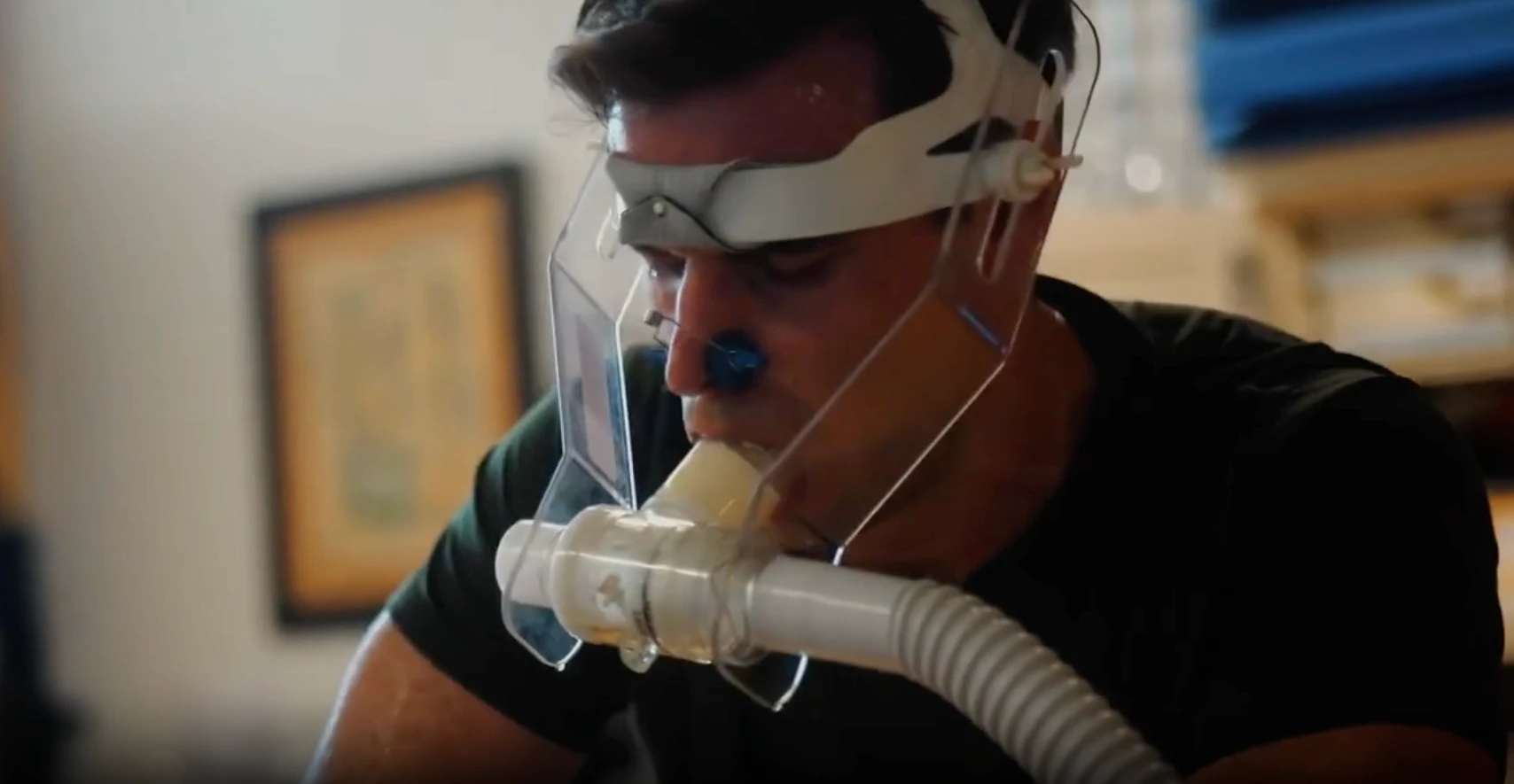
Our Co-founder and CEO Brooks Leitner is not a typical endurance athlete. His athletic background runs through competitive soccer, sprint swimming, and Olympic weightlifting. For several years before this experiment, his primary training was CrossFit, with exercise sessions rarely exceeding 30 minutes. His mile time before starting was around seven minutes and ten seconds, but a 525 lbs back squat and 330 lbs clean & jerk. By most measures, he was active but aerobically undertrained relative to his strength and power base.
The moment that changed his thinking was disarmingly simple. As he describes it: "I was in my late twenties, in decent shape by any standard measure, and I found myself completely gassed on a neighborhood hike with my wife. There was no reason I should have been huffing and puffing like that. That was the wake-up call."
After reviewing the exercise physiology literature, including Michael Joyner's meta-analysis on VO₂ Max trainability [5], Brooks landed on the Hickson Protocol as the most evidence-backed option available. To run it properly, he needed a lab, a calibrated bike, and someone who knew what they were doing. He found all three at Sacred Heart University in Connecticut, where exercise physiologist Dr. Chris Taber runs the university's exercise physiology lab. "The expertise was right in my backyard," Brooks says. "I knew I could get it done in a rigorous way."
Starting Point
Before any training began, Brooks completed two baseline VO₂ Max tests on a ParvoMedics research-grade indirect calorimetry system at Sacred Heart, one of the gold standard tools for this kind of measurement. His baseline came in at 48.9 ml/kg/min. A parallel Cooper 12-minute run test estimated 49.1 ml/kg/min, and his WHOOP wearable read 48, a remarkably tight agreement across three different measurement methods.
He also ran a comprehensive 100-plus biomarker panel through Function Health to establish a full metabolic and cardiovascular baseline before a single training session began.
The Ten Weeks
The structure of the protocol is described in detail in our previous blog (link). In practice, Brooks trained six days per week: three days of high-intensity cycling intervals calibrated weekly to his VO₂ Max wattage in the lab, three days of all-out 40-minute runs, and one formal VO₂ Max test every week at Sacred Heart to recalibrate the following week's workloads [1].
The first five weeks, by his account, were hard but deeply rewarding. "Every Monday I had an improvement in my VO₂ Max. I could see my running times going down and my distance going up. The gains were visible every single week, and that made it worth it."
Heat turned out to be a significant and underappreciated variable. Brooks initially kept the bike in his garage before moving it to his air-conditioned basement after three weeks. "A 20-degree temperature difference between a 5:30am start and an 8am run could make a measurable difference in what I was able to do. The heat impact on performance was insane, I had no idea going in."
He ran rain or shine, which he described as occasionally brutal and occasionally welcome. Saturday mornings were the hardest. "You've already done five hard sessions that week and you still have to get up early and go as hard as you possibly can on the track for 40 minutes. That never got easier."
The Plateau
Week five was the peak. Brooks reached a lab-measured VO₂ Max of 53.6 ml/kg/min and never surpassed it. From week six onward, the protocol shifted from rewarding to grueling without the payoff. "My legs just weren't built for the cumulative demand of high-volume cycling. I had the strength but not the specific endurance, and my quads paid for it. There were two full weeks where I couldn't hold the required resistance on either cycling session."
Dr. Taber confirmed what Brooks was experiencing: classic overtraining. Performance was declining despite sustained high workload, a sign of insufficient recovery rather than insufficient effort. Looking back, Brooks also identifies his carbohydrate intake, running at around 40 to 45% of total calories, as a likely contributor. "I maybe added in an extra bagel here and there, but I didn't meaningfully change my diet. In retrospect, I probably should have."
The protocol offered no flexibility for this. As designed in the original 1977 study, it's a fixed structure with no built-in adaptation for individual response [1]. "That's what the literature calls for," Brooks notes. "Any deviation is considered a negative on scientific integrity. But it doesn't translate well to the real-time adaptability of an individual."
Despite the plateau, he committed to finishing. "I had made a commitment going in, and in part because VO₂ Max is a core concept of the company we were building at the time. I wanted to give it the fullest effort I possibly could."
What the WHOOP Saw
An interesting divergence emerged in the final weeks. While Brooks' lab-measured VO₂ Max declined after week five, his WHOOP continued tracking upward, reaching an estimated 56 ml/kg/min by the end of the protocol. His resting heart rate dropped an average of four beats per minute over the 10 weeks, from around 54 to 50, with a single-night low of 44 following a rest day.
Which number reflects his true VO₂ Max is a question he finds genuinely interesting. "If you identify as a scientist, you pick the lab number. But when you're the subject on week eight of the most hellish protocol you've ever done, you don't fully trust that number either. My resting heart rate was continuing to drop, my heart rate during sessions wasn't going as high at the same workload, I knew I was physiologically fitter. I think the lab number is the truer performance measure because it captures psychological readiness and fatigue alongside physiology. But I do think my biological fitness continued to improve even after my lab scores plateaued."
His Cooper 12-minute run test at the end of the protocol estimated a VO₂ Max of 54.1, closely tracking the lab peak. His first mile time dropped from 7:13 to 6:34.
The Biomarker Data
The results from the post-protocol Function Health panel were, in Brooks' words, the most interesting part of the entire experiment.
His LDL particle number dropped from 2,251 to 1,614, a reduction of approximately 35%. Small dense LDL particles, which carry the highest cardiovascular risk, fell from 428 to 223, essentially cut in half. Total cholesterol fell from 232 to 210, LDL from 144 to 125, and apolipoprotein B from 103 to 89. Free testosterone nearly doubled, from 55.1 to 109.1, with total testosterone rising from 479 to 606, both remaining within normal range. Fasting insulin dropped from 5.5 to 3.6, consistent with improved insulin sensitivity [3]. Cortisol fell from 16.6 to 13.2. Hemoglobin and red blood cell count both increased slightly, reflecting the cardiovascular adaptations that drive improved oxygen-carrying capacity [2]. His biological age as estimated by Function Health dropped from 26.5 to 25.4. He lost four pounds, moving from 201 to 197.
None of these changes came from deliberately altering diet, sleep, or lifestyle. They came from training one upstream metric.
"What struck me most was that by focusing on a single integrative metric that has the strongest evidence base for overall health, all of these other related measures fell into place on their own," Brooks says. "I didn't change my diet. I didn't change my sleep. I just focused on VO₂ Max, and the lipids, the insulin, the testosterone, the biological age — they all moved in the right direction. That's the signal in all the noise."
The Mental Dimension
Brooks is careful to note that the protocol's impact wasn't purely physiological. "Every single day of the week was as hard as I could possibly go. Nothing in my athletic life (soccer, weightlifting, marathons, CrossFit) was as relentlessly hard as this."
What emerged from that sustained difficulty was a recalibration of what felt hard in the rest of his life. "If I could complete this session, literally everything else that day was easier. Difficult conversations, fundraising, hard decisions about the company, all of it was a fraction of what I'd already done that morning. That translated in a real way."
What He Would Do Differently
With the benefit of hindsight, Brooks has a clear list. He would have monitored continuous lactate dynamics during training sessions. He would have added a DEXA scan for visceral fat and muscle mass. He would have run more frequent biomarker panels, ideally at week five when the plateau hit, rather than only before and after. And he would have worked with a coach empowered to adapt the protocol in real time rather than holding strictly to the fixed 1977 structure [1].
"The Hickson Protocol was designed for a journal paper, not for an individual. What I'd want next time is an adaptive version of the same stimulus, one that takes into account sleep, recovery, diet, and life, and modifies programming to meet the goal over a longer time frame."
The Takeaway
Brooks finished the protocol. His VO₂ Max improved meaningfully. His biomarkers shifted substantially across the board. And his thinking about what upstream metrics can do when you move one lever that sits above everything else sharpened considerably.
"Measure what matters," he says, "and everything else will fall into place."
The Hickson Protocol, run properly and with appropriate support, is one of the most evidence-backed ways to move that lever. Whether or not you replicate it exactly, the principle it encodes is worth taking seriously: find the metric that sits upstream of everything you care about, and train it as hard as the evidence allows.
[1] Hickson RC, Bomze HA, Holloszy JO. Linear increase in aerobic power induced by a strenuous program of endurance exercise. J Appl Physiol. 1977;42(3):372–376.
[2] Holloszy JO. Biochemical adaptations in muscle: Effects of exercise on mitochondrial oxygen uptake and respiratory enzyme activity in skeletal muscle. J Biol Chem. 1967;242:2278–2282.
[3] Gibala MJ et al. Physiological adaptations to low-volume, high-intensity interval training in health and disease. J Physiol. 2012;590(5):1077–1084.
[5] Joyner MJ, Coyle EF. Endurance exercise performance: the physiology of champions. J Physiol. 2008;586(1):35–44.